Some good tourists
Published in Districte15 magazine, in November 2015
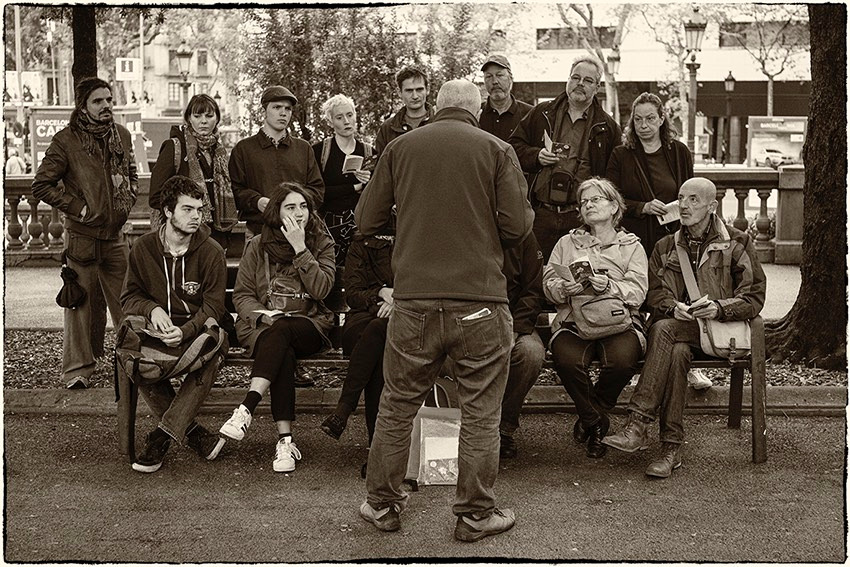
—It is the night of July 18 to 19, 1936 —says Nick, covering the entire Plaza Catalunya with his arm—. In the square there are several dozen, perhaps a few hundred, people sleeping, or at least trying to. Who are they? They are young French people who have come for the Popular Olympics.
Nick has achieved the effect he was looking for. The group of tourists listens to him with great expectation, wondering what the People's Olympics must be about and why the hell all those French people were sleeping in the square.
—Does anyone know which cities competed to organize the 1936 Olympic Games?
Two or three tourists dare to tentatively mutter a response:
—Berlin? Paris…?
—Berlin and Barcelona—Nick corrects—. And Berlin won. Keep in mind that the decision was made in 1931, when Hitler had not yet come to power. What happens is that later, once the Nazis came to power, they wanted to use the Olympics as a great propaganda operation. In many places there were protest movements, in fact some countries boycotted the Games, and Barcelona, which had lost the nomination, organized alternative, popular Olympics, with a clear anti-racist and working-class intention.
Nick illustrates his explanation with photos of the event's posters, which he shows on his iPad. Although he is somewhat hoarse today, he has the voice and diction of a Royal Shakespeare Company actor, and has mastered the art of keeping his audience extremely attentive. We have been in Plaza Catalunya for almost half an hour, reliving that night when part of the army rebelled against the legitimate government of the Republic, thus starting the war that would end with the imposition of the fascist regime of General Franco.
Nick Lloyd's are not typical guided tours. They begin days before the visit itself, with a couple of electronic messages in which he recommends preparatory readings and a selection of films and documentaries about the Civil War. Then, shortly after the tour group gathers, Nick sits them down on a bench in the square and invites them to study ("study" is the word he uses) and then to recite from memory the names and political orientation of the main agents of the conflict. For a moment, one has the feeling of being in a British boarding school. Nick justifies himself by saying that it is necessary to familiarize yourself with the acronyms of the period if you want to understand the convoluted overlap of war and revolution that took place in Barcelona between '36 and '39. "This is not a tourist visit," he warns just to begin; "It's a kind of history."
The audience that came to the tour today is quite young. Except for a couple of Irish retirees, everyone else must be around thirty years old. There are two tall, thin Swedes who seem to already have solid knowledge about the Civil War. I ask them where their interest comes from and they tell me, without going into details, that in their country they are active in radical political movements. Then I talk to a girl from Toronto, who will spend a term in Barcelona and who is very interested in what she calls anarcho-tourism. This walk through the sites of the Civil War is in fact your first contact with the city. A couple from London has also come, perhaps on their honeymoon, who at first seemed a bit shy to me. Since at first they hardly spoke, I thought that perhaps they felt a little out of place, but as the excursion has progressed we have started to chat and they have asked me very specific and insightful questions about the history of the war and about the transition to democracy (some of which, to my shame, I have had great difficulty answering). A Dutchman and a German who travel freely, and who are not short of historical knowledge, complete the group.
We now stop in front of the Continental Hotel, on Las Ramblas, where George Orwell and his wife stayed while they were in Barcelona during the war. Nick takes out a copy of Homage to Catalonia from his wallet and begins to read the paragraphs in which Orwell describes his first impressions of the city (in reality he does not read but rather recites. He knows the long text of memory and declaims it with aplomb). Lulled by Orwell's words, we managed to imagine, despite finding ourselves in front of a Desigual store, those Ramblas where revolutionary songs were played day and night, the shoeshine boxes were painted red and black, the waiters treated customers without servility and tips were prohibited.
Then the visit continues through the streets of the Gothic quarter until reaching Plaça de Sant Felip Neri, with its walls riddled with bombs from the Italian aircraft. Once again, Nick's words transport us to a morning in 1938, when the teachers of a school evacuated the students from the classrooms, without knowing that a bomb would soon fall right where they were seeking refuge. Not even the other two groups in the square (it's almost 12 o'clock, we're approaching prime-time on the tourist routes) take us out of our historical reverie.
We will still stop at a few more places, including the rickety headquarters that has been awarded to the Democratic Memorial, before finishing the tour at the La Llibertària bar, on Tallers Street, where the master class ends up mutating into something more like a gathering, and Nick tells us that descendants of the international brigade members who fought in the war often come to visit.
Already on the subway, back home, Nick explains to me with satisfaction that there are quite a few people interested in doing the route. Five days a week, ten to twelve people decide to spend a long morning walking around Barcelona and talking about the Civil War. And this has been going on for some years now.
It's hard for me to believe, because I'm used to thinking that tourists are only interested in the Sagrada Familia and the Barça museum. Skeptical, when I get home I try to check, with the help of the internet, if what Nick says is true.
Well, it seems so: the internet is abuzz with enthusiastic reviews of his five-hour history class, and hundreds of people recommend this walk as one of the best things to do in Barcelona. Among the comments, I find the following phrase:
“It is surprising that Barcelona preserves so few vestiges and commemorations of the Civil War. That brief period of workers' self-government in 1936 is one of the city's most important contributions to world history.
It is comforting that a tourist says that. It would be nice if more natives said it too. I was almost ready to believe that the city's most important contribution to world history was Lionel Messi.
Post a comment