Cosmic Overload
Originally published at La Vanguardia el 14 de Marzo de 2023
I'm not enthusiastic about people eating popcorn in the cinema. Nevertheless, the day I went to see "Everything Everywhere All at Once," circumstances led me to purchase one of those buckets filled with corn that would be enough to feed the entire audience for a couple of days. After consuming it, I left the cinema thinking that there was a scale correspondence between the movie and the popcorn serving: both were equally excessive in relation to a human's digestive capacity.
On the way back home, as I tried to make sense of what I had seen, I thought of a screenwriting professor I had years ago. The main lesson he was trying to instill in us was that we should explore the dramatic dimension of our narrative premises in all their depth. He was tired of seeing his students start with good ideas that they later wasted, due to an inability or fear to extract their full potential. Instead of that, they overloaded the screenplay with new characters, twists, and surprises, victims of a cinematographic horror vacui that paradoxically leads to the emotional emptiness of the films. I couldn't help but smile, imagining what he would have thought of the psychedelic outbursts of the Daniels.
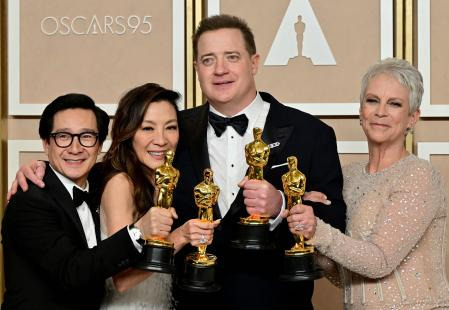
Following my professor's lead, I was hesitant to believe that "Everything Everywhere All at Once" would win the Oscar for Best Original Screenplay as well. I had more confidence in "Tar" or "The Banshees of Inisherin," which, each with their imperfections, exploit their concentrated narrative cores much more productively. For Martin Macdonagh, for example, Collin Farrell, Brendan Gleeson, and a few pints of stout are enough to craft a lovely fable about how ambition clashes with friendship. In "Tar," a slight squeak inside a high-end car generates more tension than the Daniels achieve with their whole army of multiverse fighters.
Filling a movie with thousands of jumps between an infinity of possible universes doesn't necessarily mean loading it with emotion and meaning. But minimalism and sobriety are not in vogue in Hollywood. The neglect of "The Fabelmans," perhaps Steven Spielberg's most restrained work, is ample evidence of that.
To reward an overloaded film with a lot of excess salt, the academics could have chosen "Triangle of Sadness," a film that, while not the best of Ruben Östlund's work, offers some insightful vignettes about the world we live in. The captain's dinner scene (probably one of the sequences with close-up vomiting in the history of cinema) greatly illustrates what can happen to all of us if we continue to gorge ourselves on king-size popcorn and two-and-a-half-hour multiverse delirium.
Post a comment