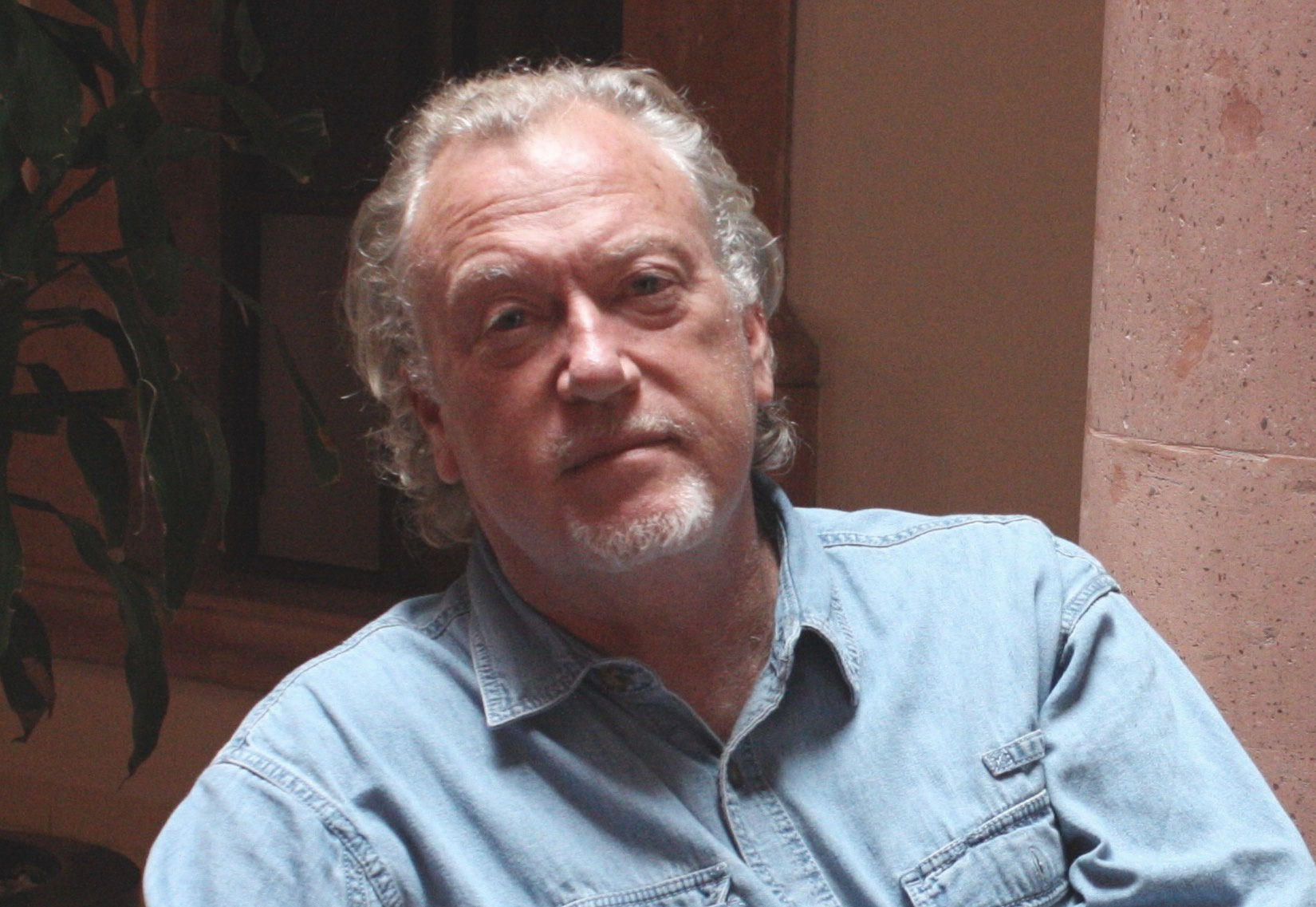
Interview with John Lee Anderson
In the eighties Jon Lee Anderson wrote about guerrilla groups from different parts of the world and realized the great influence that the figure of Ché Guevara had on all of them. That realization led him to settle in Cuba, where he ended up living with his wife and children for three years, until he completed his well-known biography of the insurgent leader. Then came other books and biographical profiles, dedicated to figures such as Pinochet, Saddam Hussein or King Juan Carlos de Borbón. He is currently working on an extensive biography of Fidel Castro, a book that is completely absorbing him. “I dream of Fidel” he confesses. “During the last few years I have dreamed many times that I had long conversations with him.”
h
Jon Lee Anderson is one of the star journalists at the prestigious magazine The New Yorker, but above all he is an insatiable adventurer. At the age of eighteen he had already traveled extensively across the five continents, and dreamed of rowing across the Atlantic and climbing Everest. His work as a reporter has led him to immerse himself in all types of conflicts and to live closely with guerrillas from all over the world. It was precisely his biography of Ché Guevara (who contributed decisively to the location of his remains, thirty years after his murder) that brought him unanimous recognition at an international level. He has received numerous awards, including the José Couso for freedom of the press. We interviewed him at the Hay Festival in Querétaro (Mexico) to talk about his career, the state of the world and the challenges of journalism.
Is it true that at the age of fourteen he was already traveling alone in Africa?
Yes, at that time I did not recognize the limits of age. My father worked in the US Foreign Service, so as a child I lived in many different countries. From the age of nine I began to have experiences that encouraged me that I could function alone in the adult world. And at twelve I started running away from home quite frequently.
However, he maintained a good relationship with his parents.
Yes, I had a good relationship with them. I didn't understand that my escapades traumatized them. They told me: What's wrong, John? What are we going to do with you? And I explained to them that I couldn't wait any longer, that I simply wanted to live now.
How did they solve it?
They asked me if I wanted to go with my uncle to Liberia. And I said: «Damn! Yeah!". My uncle Warren (my mom's older brother) was a geologist and I greatly admired him. He was a kind of mountain man, who had gone to Alaska and spent his youth living alone with the bears. I dreamed of going to Africa. because it was the only continent where we had not lived. Then I was already 13 years old.
And there began his solitary journey through the African continent...
When I was in Liberia I was dying to go to East Africa, to see the savannahs and the big animals. My parents and uncles had friends in Nairobi, Addis Abbeba or Kampala, and those friends were supposed to take care of me. But I also left their house and they didn't know what to do. In those years they did not have telephones, they used airgrams that took two weeks to arrive.
Was writing already important to you at that time?
Yes, I always had this writing thing in mind, because my whole family was a big reader. From a very young age I read many biographies and established a kind of notion of who my admirable self was. And my references were men who had “lived the life”, you understand? And that, in addition, they had an intellectual life. When it came to writers, I was always very disappointed if they had not lived an adventurous life, or if they had lived through the time of a great war without having participated in it.
I imagine he would admire people like Hemingway.
Hemingway is the most obvious, yes. He was a great reference during my adolescence. But there were also less famous people, because my first heroes were not writers, but explorers, adventurers and sometimes scientists. One was a guy named Carl Akeley, who no one knows, but he is the taxidermist and explorer who collected all the African species that are in the museum of natural history in New York.
And what were its literary references?
Jack London; Graham Green, who was less of a man of action, but who dabbled in the world that interested me; and then Kapuchinsky, which I discovered when I was twenty-five or so.
Were those characters the ones that led you towards journalism?
From the biographies I read I began to make a series of lists of the things I wanted to achieve in life[1]. For example, one of the lists included things like: crossing the Atlantic by rowing; climb Everest before 18; go to prison; know a war; to be a coal miner... And journalism became a way to continue completing my list.
Was “getting married and having three children” on that list?
No, but I took that for granted. I had always loved children, and I always wanted to have a big family. I didn't understand exactly how I would organize it, but I was always clear that it was not exclusive.
And politics? Was it somehow on your lists?
Until I was twenty I saw myself as an apolitical boy, only interested in animals and things like that. I did have social concerns, due to the influence of my parents and the things I was seeing in the world; The suspicion of the established power was very clear to me from a young age. But I was more prone to action than theory. Although in my brief journey through the university I read some politics, I did not identify with any particular doctrine.
However, he soon began to feel a certain fascination with the world of guerrillas.
Yes, I wanted to be a guerrilla. It wasn't very clear when, but at some point I wanted to fight in a war.
What did you lack to achieve it?
While in Central America I began to hear about Somoza, in Nicaragua, and at that time they were also fighting in Rodhésia, against the white minority regime. I felt a great attraction towards both conflicts, but my brother dissuaded me from Rodhésia, and in Nicaragua I did not have the contacts to get there... I was always very tempted to get involved in the insurgent world, but instead I became even certain point in his chronicler.
Does that mean that he saw journalism as an alternative to guerrilla warfare?
My work has not been a form of activism, as it is usually conceived. Rather, I have followed my intuition, and my intuition is a compound of things that have defined me. When I started there were journalists who openly sympathized with the guerrilla, and those who worked almost at the dictates of the military or the gringos at the embassy. I always felt more affinity with those who were more idealistic and tended to believe in the guerrilla, but I tried to stay in the middle to be impartial.
Did you ever hold a gun?
Yes, but a few years ago and it was in an emergency situation, in the Taliban's Afghanistan. We were repeatedly ambushed. And on one of the getaways I was with a driver who had a gun. I was next to him and they started shooting at us. A bullet hit the driver. The wound was only superficial, but at that moment I grabbed the gun and told myself that they weren't going to kill me like a sheep. I was ready to shoot, but luckily I didn't have to. Fortunately, the driver gave gas and we managed to get out of the ambush.
I guess that could be considered self-defense.
Something similar happened in Iraq and I bought a gun. But I did it to kill myself, in case it was necessary. A truck bomb had exploded near the house where I was staying, and I thought that after the bombing some jihadists would come, like a suicide commando. No one came, but from that moment on I felt very vulnerable. By then they were already cutting the throats of foreigners. I told myself that that was not going to happen to me. So I looked for something to defend myself, and, if necessary, end my own life so that those people couldn't capture me. All that was very gloomy. I had become too contaminated by the situation. I realize now. When you reach these levels of familiarity with the horrors of a conflict, you have gone too far. I have a very dark memory of that period. One contemplated death all the time. It is not recommended at all.
You have reported extensively from Syria, Iraq, Afghanistan and the Arab Spring. How do you see the situation in that region of the world?
ISIS is already on the verge of extinction as a group that controls territory, but it is obvious that the risk and propensity for jihadist nihilism will remain. In my opinion it was a big mistake when the responsible countries let them take and occupy territory. That gave them much more strength. It is very sad to say, but with great sadness I come to the conclusion that ISIS had to have been annihilated, in a devastating way. I know that would have meant many civilian deaths, but in fact there already are. Throughout this period I have felt distressed and dismayed by so much unnecessary death. If we had crushed that group at the beginning, that would have been limited.
In your opinion, when and where should this intervention have been launched?
As soon as they took Mossul. They had to have been attacked at that moment. We witnessed what they did with the Yazidis, in the summer of 2014, and how they cut the throats of all the hostages one after another. How come we just didn't do anything? How is it possible that, in the modern world, an extermination group could take territory and begin exterminating populations, boasting about it and uploading videos of their misdeeds on YouTube[3]?
What are the current perspectives?
We are now in a world that can largely neutralize jihadism. But with every attack in Europe, 100 more neo-Nazis are born. Or a thousand. Or ten thousand. We lack sensitive leaders who do not encourage racism. And not change our societies for security societies permanently.
By the way, what did you think of the reaction to the Las Ramblas attack in Barcelona?
I wrote a note praising her. I think the reaction in Barcelona was fabulous. Both that of the security forces and what the president of Catalonia said. He sent a very inclusive message. And I think the anti-intolerance marches that took place there were a great example. With all the problems there are, Spain is one of the most tolerant countries in Europe.
How do you explain it?
The preventive action of the authorities has worked well. I am not given to praising the authorities, but in Spain they have done very well. Because the actions have stopped and that has allowed us to maintain a notion of tolerance in society that has been lost in other countries.
Would you say that Spain maintains a good image internationally?
The vision of Spain continues to be positive. Despite a long-lasting recession, with very high unemployment and a lack of governance, it has managed to maintain a certain stability and a lack of panic or hysteria. However, in recent times Spain has gone into seclusion. He has decided to get off the stage of the great international public and dedicate himself to endogamous battles, between neighbors[5]. Spain could play a more active role in bringing Mediterranean societies closer, which would include North Africa, the Maghreb... I know that some are working discreetly on these issues.
And how do you see the situation in Catalonia?
There is a stubbornness, a Spanish obstinacy towards the Catalans. The New York Times itself made an editorial recently that felt very bad in Madrid.
In Spain there were very angry reactions to that editorial.
They are always like this. The strongest reactions I have ever had to any of my articles (except one about Venezuela) have been towards two of the three chronicles I have done about Spain: one about the King and the other about the Basque Country. The reactions from Madrid have always been furious. They even sent a delegation to The New Yorker to complain personally to the editor in chief. In Spain they have been very accustomed to determining what is said and what is not, and that has continued.
That makes me think about the importance of journalistic institutions. At a recent event, you were talking to the editor of the New York Times about the need for strong institutions, not just the heroism of individual journalists. How do you currently see the panorama in this sense?
There are still good journalistic institutions. With great weaknesses and some wear that is painful to see. But foundations and initiatives have sprung up, taking money from here and there to, for example, train young journalists how to save their lives in dangerous situations. Because before they didn't know, and lots of people have died because of it. It is not an entirely rosy or entirely clear picture, but it is not as dark as is sometimes said. There is a lot of effort to maintain the institutionality of journalism and strengthen it more and more.
What do you think of the role of people like Jeff Bezos, who finances the Washington Post?
I feel a little uncomfortable with this thing about big individuals buying media with their great fortunes, but from what some friends who work at the Washington Post tell me, Bezos doesn't get involved. The fact that the Post has become a great newspaper again, when three years ago we almost considered it dead, is good. But even so, I still think that is not the ideal world. The public is missing, more public solidarity.
Finally, I would like to ask you about Latin America, surely the place in the world that you know most deeply. There is talk of a decline of the left throughout the region.
The problem of the left in Latin America is that it has come to power at a time when the capitalist world was impregnable. And then they have been socialists who have governed capitalist systems. With the exception of Chávez, who has led another type of left-wing revolution, which is a mixture of left and nationalism, with populism, capitalism, and with a certain authoritarianism and personalism. In Latin America there is a decline of the modern left, but there is also a collapse of the right and the extreme right. And cases like Odebrecht have affected everyone: left, right, nationalists...
At the end of the 2000s it seemed that some countries were in an enviable situation.
We were too quick to rejoice in Brazil's prosperity, and the same thing happened with Venezuela. It is painful to see countries that after touching the sky have immolated themselves so quickly, and with such disastrous consequences for their people.
In your opinion, what is the main problem facing the countries of the region?
The great crisis in Latin America is its lack of rule of law. And the very high rates of homicides and insecurity in many countries are extremely worrying. In too many countries the underworld and the police are the same thing. That has to stop, and we have to fix it beyond the right and the left. That the government works in favor of the citizens is more important than the political tone of each president in turn.
En la década de los ochenta Jon Lee Anderson escribió sobre grupos guerrilleros de distintas partes del mundo y se dio cuenta de la gran influencia que sobre todos ellos ejercía la figura del Ché Guevara. Esa constatación le llevó a instalarse en Cuba, donde acabó viviendo con a su mujer y sus hijos durante tres años, hasta que completó su conocida biografía del líder insurgente. Luego han venido otros libros y perfiles biográficos, dedicados a personajes como Pinochet, Saddam Hussein o el Rey Juan Carlos de Borbón. Actualmente trabaja en una extensa biografía de Fidel Castro, un libro que le está absorbiendo por completo. “Sueño con Fidel” confiesa. “Durante los últimos años he soñado muchas veces que tenía largas conversaciones con él”.
Post a comment