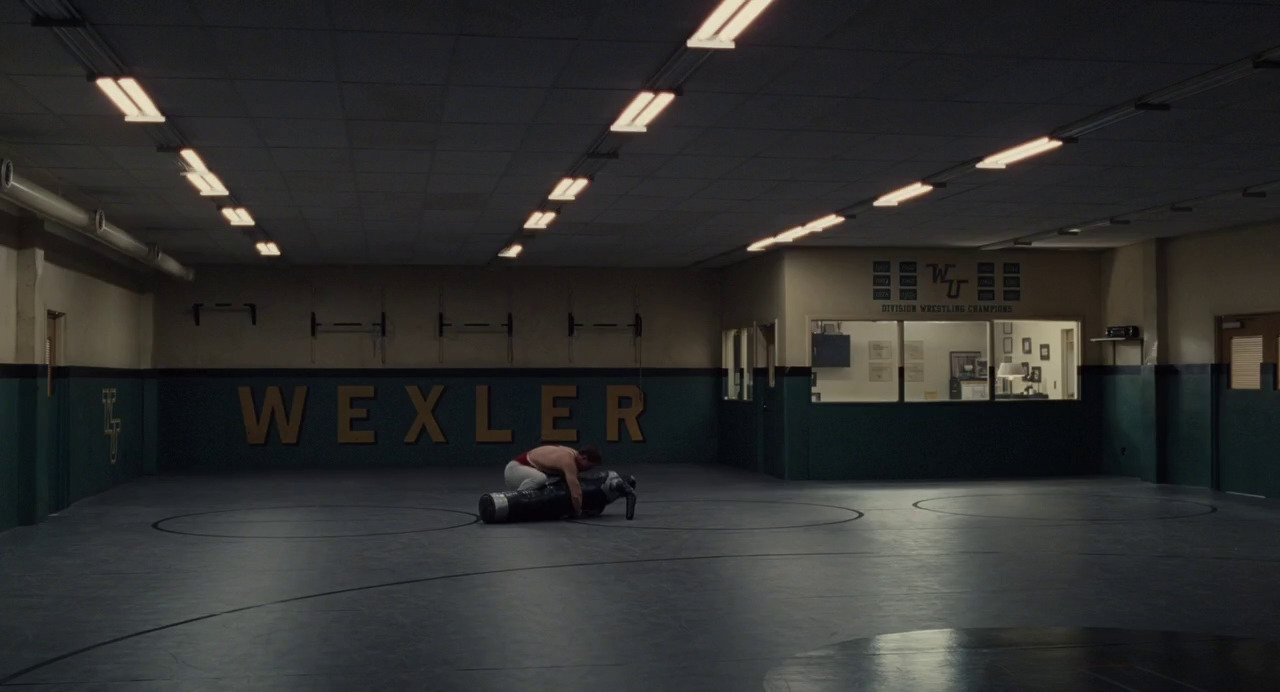
Foxcatcher and the Mina fighters
Originally published in BORDER D, June 11, 2015
Rough athletes, dented noses, bruised ears and compression bandages. This is what I found, three or four years ago, during my first visit to the Mina Wrestling Club, in Sant Adriá del Besós. I had never imagined that I would find myself involved in the sweaty universe of Greco-Roman wrestling, but as a result of my work as a producer on a film whose main plot largely took place between training rooms and weight machines (La Plaga, 2013 ), for an entire summer I lived immersed in it. In those days I met many wrestlers who oozed testosterone and spoke with thick Eastern European accents; Some even worked at night at the door of a nightclub although, to my surprise, in their daily interactions they behaved with a touching sweetness. They seemed made of peace and fight in equal parts.
At the end of one of the filming days we filmed a scene in which Iurie (that's the name of our protagonist) was seen training alone, in the semi-darkness of the evening, with the only company of a large and heavy doll like a person—the fighter's version of boxing punching bags. Iurie would knock him down violently and then get him back to his feet, practicing again and again the attacks that are executed in real combat. The sequence turned out well, and the image of Iurie with the doll—a waste of strength and anguished loneliness at the same time—ended up becoming one of the promotional images for the film. That day was archived in my memory as one of the magical moments of filming.
It had been a long time since I had thought about all that when, almost three years later, Neus and I went for a walk on a lazy winter afternoon. Soon our autopilot had led us to the door of the nearest cinema. After hesitating a little, we gave in to temptation and went to see a movie we barely knew anything about. It was called Foxcatcher. Its poster did not reveal much about its theme, but it generously featured the logo of the Cannes festival, which had crowned the film's director, Bennett Miller, with the award for Best Director. Enough to convince us to buy the ticket and risk seeing what would happen. And something unexpected happened.
The lights went out, the session began and, after a strangely poetic beginning, made with old images that showed a group of aristocrats going hunting, came a scene practically identical to the one we had filmed years before. A wrestler—who even looked a lot like Iurie—trained alone, in a dimly lit gym, hugging a helpless doll that he kept knocking down.
The similarity of the sequences gave me that same feeling, somewhere between comforting and envious, when you read in a famous book an idea that you had already had before. I looked at Neus in the dark. She didn't seem particularly surprised. I was simply intrigued to see what would come next.
Thinking about it, the coincidence was not so strange, because those types of dolls are in all Greco-Roman wrestling gyms; Furthermore, the image of the solitary and focused combatant is almost a cliché, a universal motif to represent the warrior's fear in battle. It was even more strange that we had not found out that a movie about wrestling was on the bill, especially considering that it had won important awards and was nominated for several Oscars. It had surely been somewhat overshadowed by the bitter debate between Birdman supporters and Boyhood devotees. But still... It should be more relevant to current cinema, I thought, and returned to concentrating on the screen.
The next two hours flew by. Foxcatcher shook me with a special force, as it does not often happen to me. At night I was reading some of the things that had been written about her and thus I learned, to my astonishment, to what extent the narrative was faithful to the historical facts that were told. Because Foxcatcher was based on a true story, a case that had shocked the international fighting scene in the mid-nineties, and the script had been written based on the autobiographical book of one of its protagonists - one of those true crime stories that the public loves so much. American
While reading the reviews, all those Mina fighters that I had met years ago, whom I hadn't seen in a long time, kept coming to mind. It was impossible for them not to know about that case. I'm sure everyone had run to see the movie. Surely, in fact, they hadn't talked about anything else for weeks, I told myself. I felt an overwhelming desire to know what they thought of all that.
The next day I went to visit them.
I arrived halfway through training. Everything continued more or less the same as I had seen him three years ago. The novelty, if anything, was provided by a small group of boys (and girls) no more than ten years old, who received from a meter ninety Ukrainian giant his first lessons on techniques of immobilization. Aren't they a little too young? I asked. No. The veterans convinced me that to go far you had to start early. According to them, there was nothing more educational than fight.
"Wrestling is a noble sport," Juan Carlos, the coach. «It teaches the values of sacrifice, perseverance and respect for others". Precisely because of this, Foxcatcher did not seem having liked it too much. «That moment, towards the beginning, when He headbutts his brother in the middle of training... That never happens. That's not fighting." In his view, on certain occasions the film It conveyed a somewhat distorted image of reality. "It makes us seem violent," he told me, while behind him a human body flew from backs, at the end of a fight, to make a resounding impact on the tapestry.
To my surprise, Juan Carlos was not the only one who showed a rather lukewarm opinion about Foxcatcher. Among almost all types with those I spoke to dominated a certain indifference. Many do not even had seen, and those who had done it thought, at best, cases, that "it was not bad." The conversation kept drifting away from the film to touch upon everyday concerns again and again of a fighter: weight, injuries, championships... and above all, the difficult reconciliation between work and training. If something was clear to me it was that no one had bought the Foxcatcher poster to hang in the wall of your bedroom.
Why so little enthusiasm? When I arrived I was convinced that I was going to find rather positive opinions, if only for the unusual visibility that the film would bring to that sport minority, but instead what I perceived was very little desire to talk about the subject, almost a certain discomfort. «Maybe they are not interested too much cinema, I thought as I returned home, at night, in the coastal round. In fact, many of those fighters did not even They had seen The Plague, the movie we had filmed in their own gym, so his lack of cinephilia was a plausible hypothesis.
However, during the journey it occurred to me that the reason The main reason for his discomfort had to be someone else. After all, Some fighters had gone to see the movie, I imagine that with the I hoped they would like it, but there had been something about it that made them had bothered Maybe they had found it unrealistic or maybe not. They agreed with the image it conveyed about the struggle; or such time—and this option was beginning to seem the most convincing to me—in a One way or another they had felt deceived. Because Foxcatcher was starting according to the norms of the genre, but then he began to break them, each time more freely, until it becomes something quite different from what one had imagined. What at first seemed like a film about struggle, the Olympics and the challenges of the athlete ended up becoming in a dark reflection on power and submission. Would it perhaps be Is this the root of the problem?
Let me tell the plot in four strokes, let's see if that's how We clear up the mystery a little. I promise to do it with caution, explaining enough but trying not to reveal anything essential - although in the movies it is often difficult to distinguish between the essential and the accessory.
To begin with, what we find is an approach of full-fledged sports drama: Mark Shultz (Channing Tatum), a athlete as sparse in words as he is spartan in his lifestyle, He trains with his brother David (Mark Ruffalo) to achieve the medal gold in the world championship; the hero and his trainer riding together in pursuit of a goal etched with fire on their minds hyperfocused: win, win, win. So far everything is correct. Only we are missing the antagonist. And it doesn't take long to arrive, embodied in the mysterious character of John Du Pont (Steve Carrell).
The strange thing is that Du Pont, who according to the manual should be another strongman fighter willing to put all his muscles between Mark and the world title, he is nothing more than an older man (he is close to sixty), that would barely support a light sporting activity. And on top of that, in Instead of putting obstacles in our hero's path, he seems determined in helping you.
Du Pont is an eccentric millionaire, heir to a great family of industrialists, who after contacting Mark through his secretary personal meeting with him at his aristocratic mansion in Delaware - he sends a helicopter to look for him—and once he has him sitting on the soft sofa of the salon-library offers to finance your training without limits Olympian and that of his brother. A difficult proposal to refuse that Mark, Of course, accept.
At this point we can still think that the race for medals will constitute the central axis of the film—despite the fact that the Du Pont's ambiguous, presumably dark, intentions should having warned us in the opposite direction. Furthermore, Bennett Miller knows to what extent our minds are contaminated by Roky I, II, III, IV, V and their infinite variations, so he has fun feinting with give us another spoonful of that hackneyed stew made from resurrections miraculous and combats that change sign at the last second. But little by little we are realizing that the fighting, when it comes, They pass through the footage as if on tiptoe, as if they were afraid to mislead us. of the true core of the narrative.
And Miller is very little interested in who is going to win the championship or how much you are going to suffer to achieve it; all this goes relegating it to a discreet secondary plot because in what really What he wants us to focus on is the personality of Du Pont and his every more and more less equivocal. We have already said that at the beginning they were shrouded in a certain mystery. Well, as they are revealed It is evident that the Greco-Roman struggle is not so much the topic as the stage, a colorful backdrop on which a drama much more violent than any combat.
What is this drama? Well, one not too different from the one grips most people: the will to be other. Du Pont wants leave behind his life as a mediocre man, afraid of his mother and prisoner of his fortune; wants to transform into someone different from who in reality is, more heroic, more triumphant and more revered, and what desires with religious fervor. He wants, speaking clearly, to make his dreams come true. fantasies; a desire not very different from that harbored by a good part of the humanity.
But, unlike much of humanity, Du Pont is arch-millionaire. He does not have to settle, as happens to almost all of us. everyone else, by imaginatively decorating their profile on the networks social events or exaggerating at convenience certain small anecdotes of his Biography. Du Pont plays big. Leaning on your fortune inexhaustible buys wills, distributes donations, maintains a salary court of sycophants and even commissions self-praising videos to reporting professionals (to call them something). The fiction that he constructs for himself is a true blockbuster. AND It is there, and not in the outcome of any combat, where the crumb of Foxcatcher.
Does this sound familiar to you? This imposture and auto-fiction is the fashion theme. And it is not surprising, if we take into account that today We all live more or less immersed in a continuous retransmission of our life. The distance between our intimate being and the image that what we project into cyberspace is growing rapidly, and I think that This dislocation floods every corner of Foxcatcher—even if it does so in a in a more indirect and less sparkling way than combat. The struggle, at the end of the day, is nothing more than a vehicle to raise the problem, the scaffolding that the director needs to build his narration but which he quickly withdraws once he has fulfilled his committed, so that what is really important can be contemplated in all its magnitude.
Weeks after having seen Foxcatcher, the images one has stored in the retina are not those of any combat, but those of Du Pont instructing Mark to refer to to him in almost reverential terms, or the scene in which David is seen forced to say that Du Pont is "his mentor." In a movie full of world championships, muscles in tension and agonizing countdowns, the sequence that without a doubt contains more drama is a scene intimate and contemplative that shows us Du Pont, alone, in his house, looking into the magic mirror of a television monitor; a daffodil contemporary, so eager for adulation that he does not hesitate to falsify himself himself to the most absolute pathos. In a society of individuals split between an endless number of virtual identities, the madness of Du Pont enlightens us more than we would like.
Seen what I had seen, I told myself when I got home, maybe it wasn't so strange that Foxcatcher had not raised passions in the Mine Club. The fighters I spoke to would surely have preferred that the Mark's exploits had more prominence, instead of being left relegated to second place by the tripigames of the director and the Du Pont dementia.
Also, for once Greco-Roman wrestling appears in a movie, It's a shame that he does it as a mere scenario for fantasies. egomaniacs of a crazy millionaire. In fact, I left the cinema myself thinking that perhaps it would have been better to set Du's story Put yourself in another environment: politics, high finance, the leadership of business power... Perhaps it would have been easier for us to recognize in him a figure that is everywhere, a demon that, incarnated in different people, we see every day in the newspapers, the news and other theaters of social respectability. How many tycoons do not They try, through donations and the press office, to carve out a improbable reputation of philanthropists and humanists? The payroll is endless. They start with a biographical profile in the supplement Sunday and in the blink of an eye they find themselves paying a American lobby to get them a decoration tailored to their greatness. Powerful egos resist temptations poorly hagiographic.
But there was still something more. There was another reason why, in the club from La Mina, Foxcatcher was a tough nut to crack. A reason not I only discovered the day after my visit, as I began to writing these lines, when, mid-morning, I received a message from Juan Carlos, the coach.
"I saw Du Pont fight," he said. "A shame".
It must have been the year 1994, and Juan Carlos, who at that time was still He competed, he had attended the Nice Tournament. Du Pont too, and there was made as a fighter. He competed in the veterans section, against an Algerian who lost inexplicably, since he was more stronger, more agile and more technical. Juan Carlos understood, years later, that Du Pont was one of those rigged battles with which the old man a history of false victories was fabricated. But at that time not he wanted to realize. Everyone saw Du Pont as a respectable benefactor of wrestling, and if anyone doubted it, he kept it very well If I said it, the money tap would not be turned off.
Perhaps that is why, years later, Juan Carlos was unable to enjoy the movie. Surely the thorn of having once believed that man had been choked, and now seeing in the cinema the The dark outcome of his story was too painful for him. EITHER Maybe Foxcatcher simply made him uncomfortable, just as it made me uncomfortable. me, because it's one of those movies that dissects evil too much well enough not to be disturbing.
In researching this article I have read some biographical notes about rich and powerful characters—long lists of achievements, successes and recognitions—and I have believed almost nothing. Maybe this is what best of Foxcatcher. That, after watching it, you have a critical sense sharper. Just like Joan Fontcuberta's exhibitions, Foxcatcher acts as a vaccine against flattery, gullibility and lies power. See it and you will believe me.
Post a comment