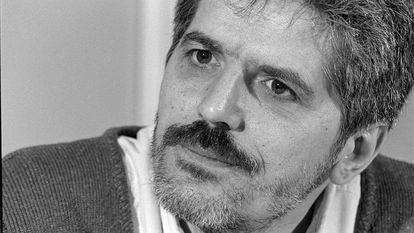
Inherit writing
Text for the volume "Why I write", edited by the Hay Festival and published by the Gris Tormenta publishing house (Mexico) in 2013
When I was about eight years old, my grandfather started writing a weekly article for El eco de Sitges, the local newspaper of the city where he spent his summers. . I think my grandfather had always had a certain inclination towards writing, but his creative impulses had found little room to develop in the midst of a life dedicated to work and family (five children in his care). It was my mother who convinced him to take advantage of the joy of retirement to dust off his literary talents. Thus began more than thirteen years of continuous, systematic writing, which each week produced a long article titled with a single word, first written by hand, on the dining room chair, and then written out in the office, with the help of an Underwood whose keyboard had to be hit with enormous force, so that a carbon copy was also printed behind the first page.
Between those two moments (the writing of the first original and the final typing) an intermediate process was always carried out, of which in a certain way I was a part: during the after-dinner meal, after the family meal, my grandfather read to us out loud. read that week's article, like a good actor reciting a classic text. These readings served him to evaluate the quality of the piece or detect the need for some correction, and they served me—I realize now—to internalize little by little the fundamental lesson of the love of words. Reviewing all of his work today, I discover with amazement that I must have attended those ritual readings at least six hundred times, the first when I was a child and the last when I was already a university student. They say that important things almost always happen around a table. It is not surprising, then, that this literary diet left a lasting mark on me.
In my family, furthermore, my grandfather was not the only one who wrote. Next to his sonorous articles was the much quieter, discreet, I would even say somewhat mysterious writing, starring my father. The only thing I knew about her was that my father spent half his life in front of the keyboard. Novels, books of essays, and piles of articles on the topics that concerned him came out of his table, with an abundance that only declined when a bad illness got in the way. My father never read a line aloud to me, and I never knew what he was writing, but I understood that, in a way, his life depended on it.
In view of this background, it is somewhat logical that, when years later I myself began to write regularly, I did not have the sensation of breaking new ground, but rather of moving in a familiar environment, where I had already taken some walks. So the question of why write was never central to me, or, to be more exact, it was only indirectly so. It's not that I felt that my father or my grandfather had already answered it for me, but that with their example they had transmitted to me the certainty that, whether I wanted to or not, I would end up writing. Without a doubt, when writing it was better to find a meaning; but the need for writing was to a certain extent prior to writing itself, just as the need for language is—paradoxically—prior to the words themselves.
Be that as it may, over the years I have thought a lot about why to write, and I have broken down this question into the pile of questions that make it up: what to write, the first and most important ; and then how write; for whom to write, or against whom to write; ending with the great question, both theoretical and practical:what space should we give to writing within life? Because writing the way you write when you are finishing a book—writing as many hours as you can and spending the rest regretting that you are not doing it—is not the same as writing sporadically, depending on your mood, with the sole purpose of writing. objective of finding some internal appeasement; Nor is it the same to aspire to much—to change the world through great novels, for example—as to be content with organizing the fragments of one's own life through writing.
As expected, I have not found fixed answers to these questions. I oscillate between a more intimate, carefree (and therefore often fresher) writing, and another that I try to make public, in which I end up pouring much more effort, trying - without much success - to condense in it everything I know and that I am. Lately I have been dedicating a lot of time to scripts, a somewhat decaffeinated form of writing that nevertheless reconciles it, when lucky, with the needs of the pocket. I always aspire to seek a balance between story and reflection, to find a way that combines the generality of reasoning with the fluidity of a story; the dreamed communion between the abstract and the concrete. Like my father, I try to make my texts permeable to all topics, from political economy to adolescent love, from my little adventures to the thoughts of great wise men. Of course, I am never satisfied.
My father died just a year ago, without having written enough. In his last days, when the illness no longer allowed him to face the keyboard, the pain of that helplessness was what hurt us (him and those around him) the most. He dreamed of a book that never came to be and that, in a way, I regret having inherited. Perhaps those absences, (that of my father and that of his last book), are the main force that now pushes me to write; the intimate conviction that he sowed a seed that it is my turn to make flourish.
Post a comment